
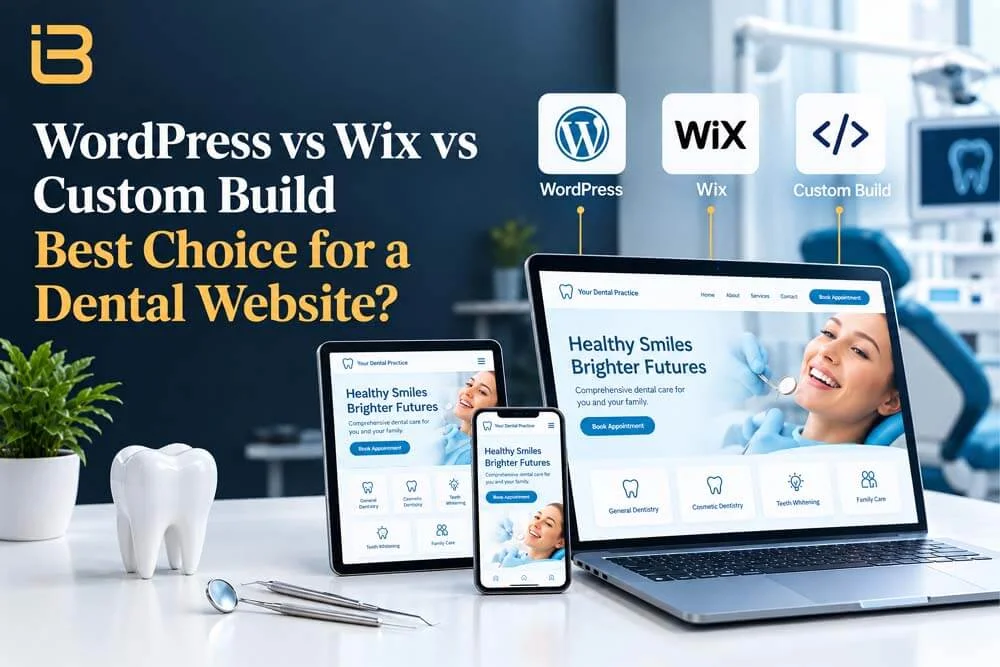
To help you make an informed decision for your practice, this article compares WordPress, Wix, and Custom Builds across key factors like user-friendliness, SEO capability, HIPAA compliance, and maintenance.
| Feature | Wix | WordPress | Custom Build |
|---|---|---|---|
| Best For | Brand-new solo startups | Growing & established clinics | Enterprise & multi-location practices |
| Upfront Cost | Very Low ($0 – $500) | Moderate ($2,500 – $8,000) | High ($15,000 – $35,000+) |
| Local SEO Power | Basic / Limited | Industry Standard | Excellent (Requires Dev setup) |
| HIPAA & Integrations | Via 3rd-party embeds | Deep custom plugin/API support | Bespoke, military-grade security |
| Data Ownership | Locked to Wix | 100% Full Ownership | 100% Full Ownership |
| Maintenance | 100% Hands-off | Periodic updates/backups | High (Requires Dev retainer) |
Before comparing these platforms head to head, it helps to understand what each platform actually offers and how they function.
When comparing WordPress vs Wix, the primary distinction comes down to ease of use versus long-term flexibility.
Wix is designed for simplicity. For a small or brand-new dental practice, Wix allows you to pick a pre-designed template, customize text, and publish quickly without touching code. Hosting, updates, and basic security are managed for you. However, this convenience comes with strict limits. As your dental practice expands and requires advanced feature integration such as custom patient portals, online appointment scheduling systems, or complex SEO setups Wix often hits a glass ceiling. Furthermore, you cannot easily migrate a Wix website to another host if you grow dissatisfied with their platform.
WordPress, on the other hand, demands slightly more setup and maintenance, but it delivers unmatched versatility. With thousands of plugins, you can integrate specialized dental software, real-time booking engines, and multi-location directories. Additionally, WordPress gives you full ownership of your site files and data. Consequently, if your dental practice plans to grow, run targeted digital marketing campaigns, or optimize heavily for local search results, WordPress offers significantly more long-term value than Wix.
The comparison of Wix vs Custom Build highlights two complete opposites on the web development spectrum.
When evaluating WordPress vs Custom Build, practice owners are comparing an open-source framework against a completely custom solution.
A Custom Build provides ultimate control, maximum security, and unparalleled page performance. Because the codebase is proprietary, it does not rely on third-party plugins that could introduce security vulnerabilities or performance drag. For large enterprise dental networks or specialized surgical clinics requiring unique software integrations and custom database structures, a bespoke build can be an excellent choice. Nevertheless, modifying a custom site almost always requires hiring specialized developers, which increases long term maintenance costs.
WordPress balances high end capability with accessible management. It provides open source flexibility, meaning you can achieve custom designs, tailored user journeys, and robust functionality without writing code from scratch. Thanks to a vast global developer ecosystem, you are never locked into a single agency or developer. Furthermore, managing daily content updates, publishing blog posts, or updating staff profiles on WordPress can be handled easily by your front-desk team without technical assistance.