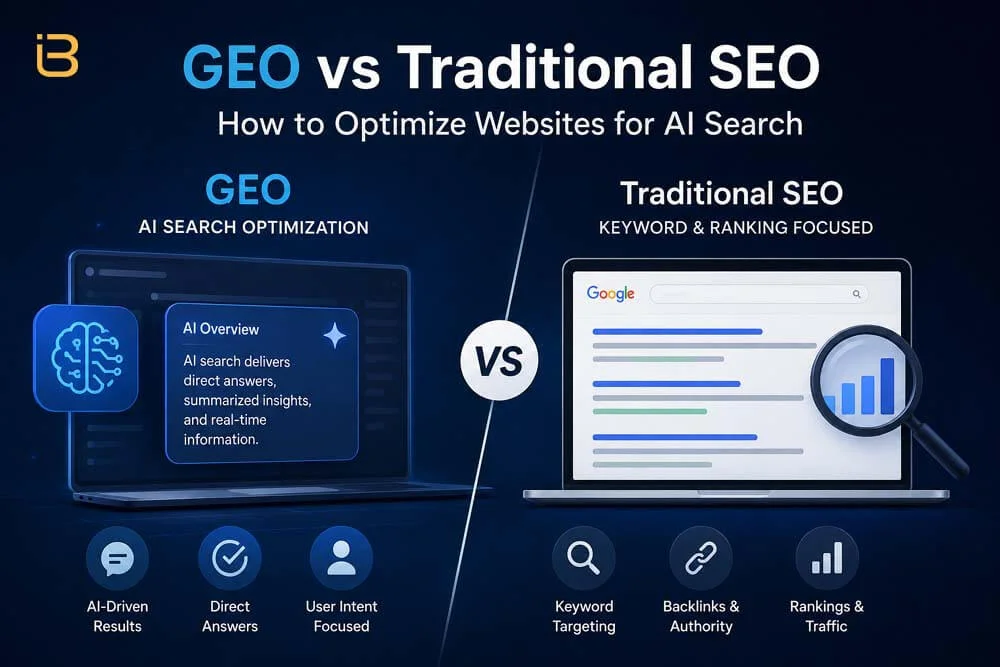
Today, conversational AI platforms like ChatGPT, Perplexity, Claude, and Google AI Overviews are changing how users locate information. Instead of scrolling through a list of ten blue links, searchers receive synthesized, real-time answers directly inside the interface.
This architectural shift introduces Generative Engine Optimization (GEO) alongside traditional Search Engine Optimization (SEO). To remain competitive, modern web platforms must adjust their technical architecture and content delivery strategies to satisfy both traditional indexers and large language model (LLM) crawlers.
What Is Traditional SEO?
Traditional SEO is the practice of structuring, writing, and technically optimizing a website so search engine algorithms rank its pages near the top of organic search results. Search engines like Google execute this through automated web crawlers (spiders) that discover, index, and organize web pages based on established ranking criteria.
Key components of traditional SEO include:
The primary objective of traditional SEO remains direct: drive qualified traffic from the search engine directly to your website.
What Is Generative Engine Optimization (GEO)?
Generative Engine Optimization (GEO) is the strategic process of optimizing content and technical infrastructure so that AI-driven engines extract, synthesize, and cite your brand as an authoritative source in generated answers.
Unlike standard search engines that index pages to display external hyperlinks, AI engines construct custom, natural-language responses to user prompts. GEO shifts the goal from earning a click to winning a citation or recommendation within the AI interface.
Traditional SEO: Query → Search Engine → Ranked Link List → User Clicks Webpage
GEO Strategy: Prompt → AI Engine → Synthesized Answer + Citations → User Reads Recommendation
Core Differences: GEO vs Traditional SEO
While GEO builds upon foundational SEO principles, the mechanisms underlying prompt-based retrieval require distinct tactics.
1. From Keywords to Natural-Language Prompts
Traditional searchers use shorthand terms. AI users ask detailed, conversational questions containing context, constraints, and background details. GEO requires content designed to answer complex prompts directly rather than relying solely on exact-match short keywords.
2. From Clicks to Conversational Recommendations
In traditional search, a user visits your landing page to read your content. In AI search, the AI model synthesizes information from multiple online sources into one response. If your content is clear, factual, and well-structured, the AI will pull your specific data points and credit your website in its citation box.
3. Verification and Factual Consensus
Traditional algorithms can rank a page with clever keyword placement and strong link profiles even if the content is thin. Large language models evaluate cross-web consensus. They verify whether your statements align with reputable industry publications, third-party reviews, and reliable digital sources.
Technical Web Development Strategies for GEO
Optimizing for AI engines requires specific adjustments at the code level. If AI crawlers cannot cleanly parse your site structure, your content remains invisible to LLM retrieval systems.
Prioritize Server-Side Rendering (SSR) Over Client-Side JavaScript
Many AI crawlers (such as GPTBot or ClaudeBot) process web pages with limited JavaScript rendering capacity. If your core content depends on client-side JavaScript execution, AI bots may record blank pages.
Implement Comprehensive Structured Schema Markup
Structured data (JSON-LD) serves as a universal translator for search algorithms and language models. Schema explicitly identifies entities, relationships, prices, authors, and FAQs without ambiguity.
Configure robots.txt and llms.txt
To allow AI search discovery, explicitly permit legitimate AI search crawlers in your robots.txt file (e.g., PerplexityBot, OAI-SearchBot).
Additionally, adopt the emerging web standard llms.txt file. Placed in your website’s root directory, an llms.txt file acts as a curated sitemap specifically formatted in Markdown for language models, guiding AI bots directly to your core documentation and high-value pages.
On-Page Content Tactics for AI Search Optimization
Winning citations in AI responses requires structural clarity and verifiable authority.
1. Adopt the Bottom Line Up Front (BLUF) Structure
Language models extract concise answers. Start sections with a direct, 2–3 sentence answer to the target prompt before elaborating with deeper analysis. This provides AI crawlers with clean, quotable content blocks.
2. Incorporate Statistics, Quotes, and Original Data
Research demonstrates that including original statistical data, expert quotes, and precise figures significantly boosts an article’s citation probability in generative models. Vague statements like many businesses save money fail to capture AI attention, whereas “organizations reduce operational costs by 34% through automated workflows” gives LLMs concrete data to cite.
3. Use Clear Semantic Headings and Tables
4. Strengthen E-E-A-T (Experience, Expertise, Authoritativeness, Trustworthiness)
AI engines heavily filter for safety and accuracy.
How to Combine SEO and GEO into a Unified Strategy
You do not need to choose between SEO and GEO. In fact, they reinforce one another:
Future-Proof Your Digital Presence with ibrism
Preparing your website for the age of AI search requires modern web engineering, clean code architecture, and high-performance technology. At ibrism, we build custom digital solutions that bridge the gap between technical web development and modern search visibility.
As a premier agency solution partner, ibrism specializes in:
Whether you are a marketing agency looking to expand your technical execution capabilities or a business aiming to modernize your digital platform, Ibrism delivers white-label reliability, modern AI tools, and robust software engineering.
Conclusion
The evolution from traditional search engines to generative AI search represents a new era in digital marketing. Traditional SEO remains essential for driving direct web traffic, but Generative Engine Optimization ensures your brand stays visible as searchers move toward conversational discovery.
By building lightweight, server-side rendered web applications, implementing clean schema markup, and publishing direct, data-backed content, you position your web platforms to thrive across both traditional SERPs and AI generated answers.