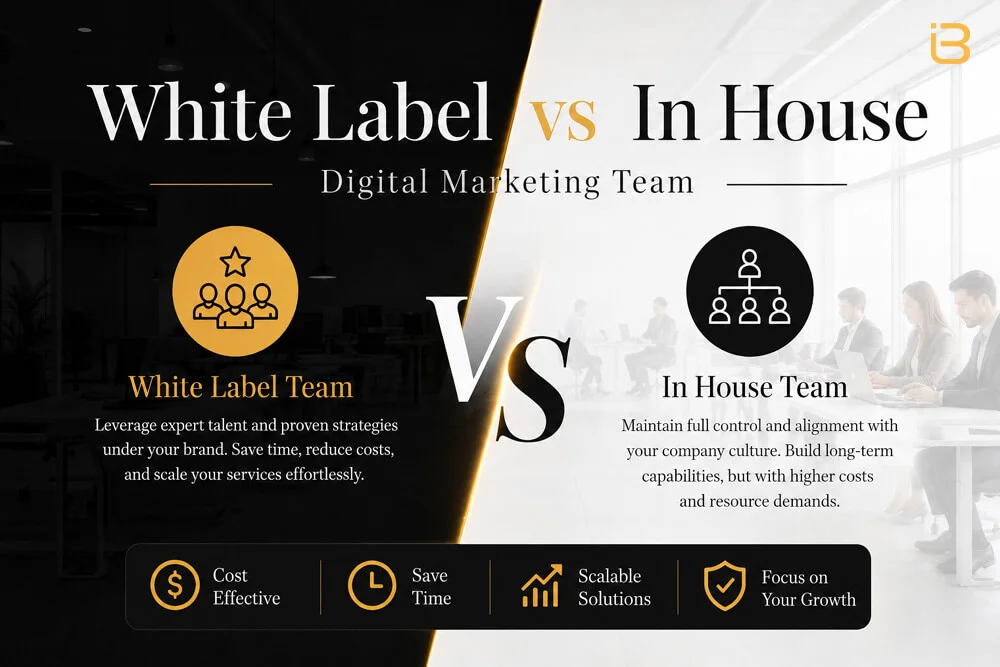
is no longer the only option. In fact, relying solely on full time employees can sometimes limit your growth.
White label services have emerged as an incredibly influential alternative, permitting businesses to deliver high quality digital solutions under their own brand name. This model allows you to scale smoothly without the stress of recruiting, training, or managing an internal production department. By understanding the core mechanics of both approaches, your agency can make an informed choice that maximizes profitability and keeps your clients completely satisfied.
An in house team comprises professionals hired directly by an agency to manage all development and marketing activities internally. Unlike collaborating with an outside vendor, this team is entirely unified into your organization’s daily operations, core goals, and corporate culture.
To run a successful digital production house, agencies usually need to employ multiple full time specialists. These standard roles typically include:
Maintaining an internal workforce offers several distinct benefits for specific business structures. First, you gain complete, direct control over the daily execution of your active projects. Second, your staff develops a deep, organic understanding of your unique brand voice over time. Finally, having team members available during standard office hours makes immediate collaboration relatively straightforward.
Despite these clear benefits, relying exclusively on internal employees introduces heavy operational burdens. Recruitment and onboarding are incredibly time consuming and expensive processes. Furthermore, you face fixed monthly salary costs and benefits, regardless of whether your client workload is heavy or light. If a key developer suddenly leaves your company, your active projects can suffer from severe delays, risking your market reputation.
White label digital production is a model where a specialized third party provider delivers technical services that you resell under your own brand identity. The end client never distinguishes that an outside partner is involved in the process. Consequently, your agency remains the exclusive, public face of the service from start to finish.
Hiring full time employees means paying consistent overhead costs even when your client acquisition fluctuates seasonally. Conversely, a white label partnership allows you to control costs by paying strictly per project or via flexible retainers. This variable cost model keeps your profit margins healthy during slower months while protecting your cash flow.
Finding the right technical talent and training them to match your standards can take months of valuable time. With a trusted white label partner, your new client projects can launch almost instantly. This rapid speed is critical when you need to onboard clients quickly or react to competitive market shifts.
When your agency signs five or ten new clients at once, an internal team quickly becomes an operational bottleneck. Employees experience burnout, which leads to missed deadlines and declining quality. White label services expand your delivery capacity seamlessly, allowing you to grow your client list without adding a single internal manager.
Managing an internal digital team involves constant performance reviews, handling sick leaves, organizing vacations, and dealing with turnover. A white label partner completely eliminates these complex HR responsibilities. The partner agency takes care of quality control and staffing internally, leaving you free to focus entirely on high level strategy.
If you want to introduce a new service like specialized WordPress maintenance, hiring a full time expert upfront is highly risky. Utilizing white label services allows you to test the market demand completely risk free. If your clients show great interest, you can scale the service up smoothly, but if demand remains low, you can pivot without suffering financial losses.
While outsourcing offers massive advantages, maintaining a small internal presence can be beneficial under specific circumstances. For instance, if your business has a highly narrow, singular focus that rarely changes, an internal team works well. Similarly, organizations with massive, flexible budgets can afford to sustain a large internal department for long term brand storytelling.
However, modern digital agencies successfully overcome this dilemma by adopting a highly efficient hybrid model. They maintain a small, agile in house team to manage client relationships, sales, and high level strategy. Concurrently, they outsource all heavy development, coding, and technical fulfillment to a dedicated white label agency.