When these opportunities arise, traditional agency operators are usually left with three frustrating options, each carrying its own set of structural tradeoffs.
You can decline the project entirely, which means leaving thousands of dollars in revenue on the table and risking that the client takes their entire marketing budget to a full service competitor. You can rush to hire a full time, in house developer, which immediately saddles your business with heavy, permanent overhead costs before you’ve even proven the long term demand. Or, you can roll the dice on unpredictable freelancers, routinely accepting high risks around missed deadlines, ghosting, and inconsistent code quality.
Fortunately, modern digital agencies have access to a highly strategic fourth path White Label Web Development.
By partnering with a dedicated, professional white label development firm, you gain an elite engineering arm that builds entirely under your brand, remains completely invisible to your end clients, and delivers flawless technical work as if it came directly from your internal team. For ambitious agencies looking to scale their revenue without adding fixed operational overhead, this model creates ultimate operational flexibility without sacrificing delivery capacity or output quality.
At its core, white label web development is an architectural partnership where a specialized third party technical team builds websites, applications, and digital platforms on behalf of an agency. Once the development is complete, the agency delivers the finished product to its client under its own brand name, using its own logos, invoices, and presentation decks. The end client never knows who actually wrote the source code, configured the databases, or optimized the server architecture.
From an agency operator’s perspective, the defining difference between true white label development and standard outsourcing or freelancing is absolute control over the client experience.
Standard outsourcing setups often fall apart because the external vendor wants credit, attempts to communicate directly with the client, or leaves behind digital footprints. In contrast, premium white label partnerships are built with strict, non negotiable invisibility protocols baked into the contract:
You remain the sole point of contact, the strategic advisor, and the absolute owner of the client relationship.
This model is a standard, highly respected commercial practice across the global tech sector, functioning exactly like private label manufacturing does in premium retail. You are effectively reselling an elite, specialized technical service under your own premium brand markup, optimizing both your service offerings and your profit margins simultaneously.
Where this model becomes immensely valuable is in how it fundamentally alters an agency’s operational capacity. In the agency landscape, three operational bottlenecks manifest repeatedly:
In every single one of these scenarios, the white label model instantly transforms missed opportunities and rejected briefs into highly profitable, deliverable client projects.
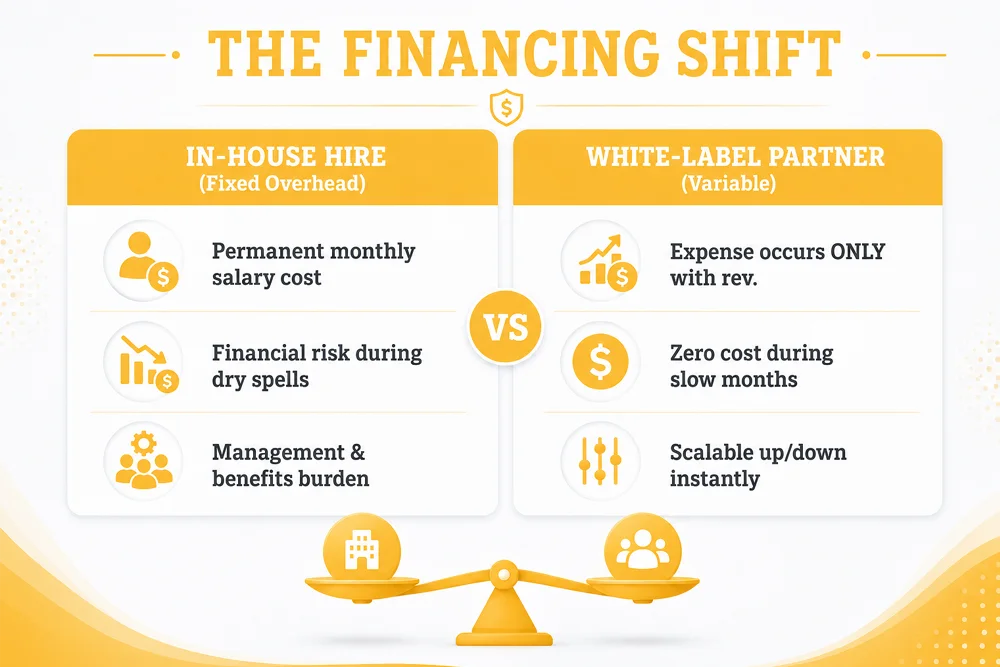
The financial math behind building an internal engineering team vs. leveraging white label development is stark. According to global tech recruiting benchmarks, hiring a qualified, mid to senior level full time web developer carries an average base salary exceeding $100,000 to $130,000 per year. When you factor in recruitment fees, health benefits, paid time off, hardware, software licenses, and management overhead, that figure skyrockets.
Crucially, an in house salary is a fixed cost. You must pay it every single month, regardless of whether your sales pipeline is overflowing or completely dry. If you experience a two month lull in web design sales, your profit margins are severely eroded by idle headcount costs.
White label web development completely re engineers this equation by shifting production costs into a purely variable model. When you work with a partner like ibrism, you pay strictly on a project by project or structured engagement basis meaning you only incur development expenses when there is direct, guaranteed client revenue attached to it.
This fundamental financial shift yields two immediate competitive advantages:
Your agency can confidently sign five major enterprise website projects next month without panic. You don’t have to spend weeks interviewing candidates or onboarding staff. Your white label partner absorbs the sudden spike in production volume. Conversely, if your pipeline slows down during the holiday season, you can scale back your development utilization instantly, carrying zero idle overhead or financial strain.
You can instantly rewrite your agency’s capability deck. Instead of pitching basic, templated websites, you can confidently sell advanced digital transformations, highly optimized custom landing pages engineered for maximum conversion, deep API third party integrations, and bespoke content management systems. You can fulfill these high ticket services seamlessly without altering a single aspect of your core internal structure.
By completely offloading the intense, time consuming production layer of coding and debugging, agency founders and account managers can reinvest their valuable energy into higher leverage business activities brand strategy, deep client relationship management, upselling, and aggressive pipeline growth. That is exactly where true agency profitability and enterprise value are built.
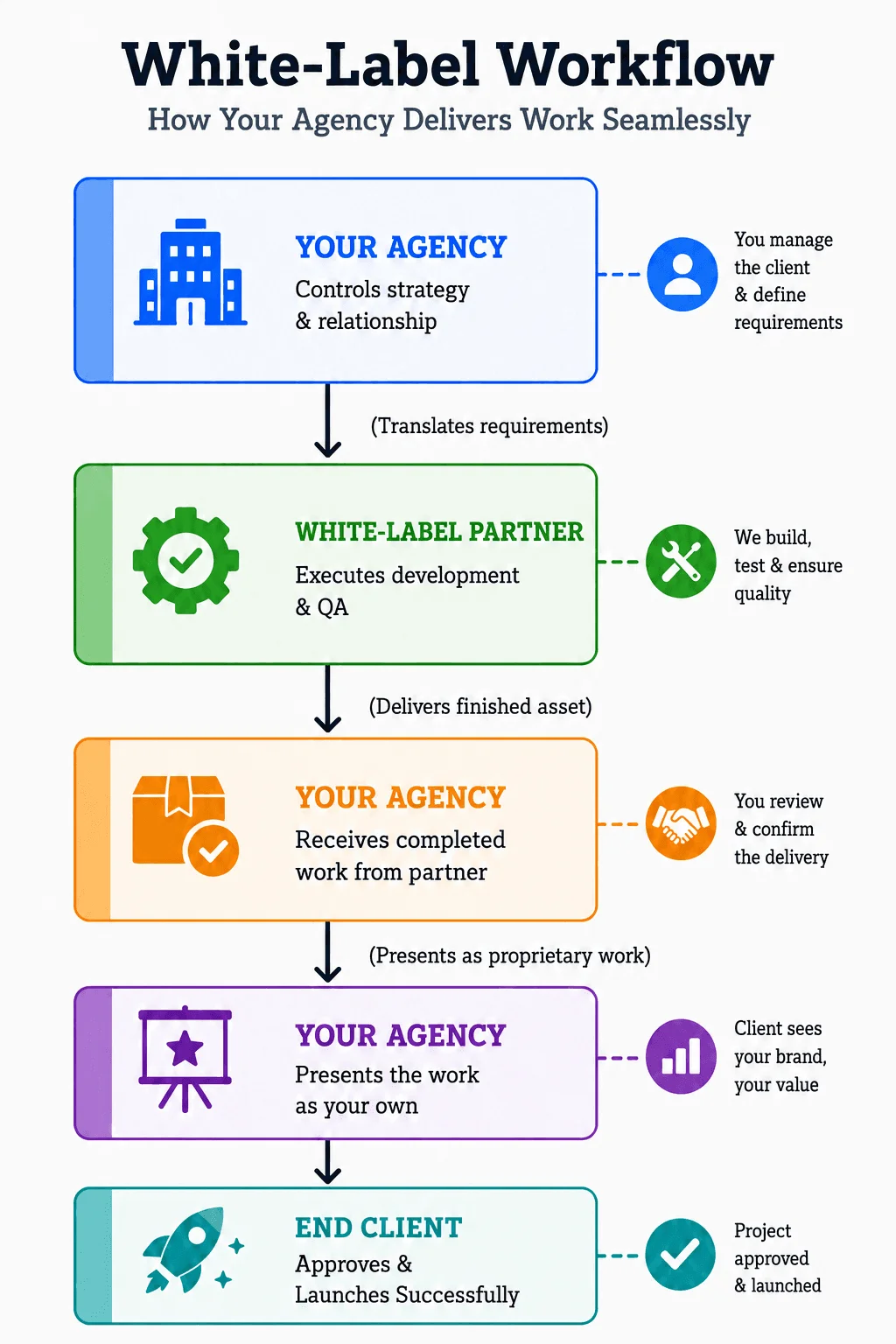
From the agency’s operational perspective, executing a white label partnership is not about casually throwing work over the fence to an untrusted vendor. It is a highly synchronized, strategic extension of your delivery team. You retain absolute ownership of the customer journey, the strategic vision, and the final sign off, while your white label developer acts as your silent, high performance production engine.
A comprehensive white label partner doesn’t just hand back raw, unvetted code. They manage a comprehensive production ecosystem supporting the entire web lifecycle:
To maintain a flawless illusion of in house execution, the daily operational workflow runs systematically through a structured, multi step process:
At absolutely no point in this lifecycle does the development team cross the line into client communication. That total separation is what preserves your brand equity, elevates your agency’s perceived technical capability, and keeps the client experience flawlessly consistent.
One of the most common pitfalls agencies face when selecting a development resource is choosing a generic generalist team that claims to do everything but masters nothing. Platform specialization directly dictates the speed, security, and scalability of your client deliverables.
For modern agencies focusing heavily on conversion rate optimization (CRO) and high impact marketing funnels, platform choices are critical. For example, if your agency delivers custom, high converting landing pages engineered to maximize paid ad traffic, you cannot rely on slow, clunky, out of the box templates. You need a partner who deeply understands clean asset optimization, mobile responsiveness, semantic code structures, and ultra fast page speeds.
Whether your client requires specialized WordPress ecosystems, tailored e commerce structures, or highly customized web architectures, working with a partner that brings deep platform specific mastery ensures that complex edge cases, third party API configurations, and performance bottlenecks are handled perfectly before they ever reach your client’s radar.
Choosing a white label development partner is fundamentally an exercise in operational risk management. Because you are trusting an external team to build products that carry your company’s name, reputation, and client trust, your evaluation process must look deep past flashy portfolios. You need to focus heavily on operational security, reliability, and predictability.
When vetting a potential white label partner, evaluate them against these critical operational criteria:
You must ask how their engineers are screened and vetted. Does the partner employ rigorously tested professionals with proven engineering backgrounds, or do they simply pass your work down to unvetted subcontractors? A partner with a strict internal screening process guarantees consistent code quality across every project you feed them.
A true white label partner treats confidentiality as a foundational pillar of their business. They must willingly sign comprehensive Non Disclosure Agreements (NDAs), strictly enforce a zero direct client contact policy, and guarantee that no project built for you will ever appear in their public case studies or portfolios. If there is even a slight hesitation regarding complete invisibility, you are dealing with a standard outsourcing shop, not a dedicated white label partner.
Digital projects rarely end the second a site goes live. Clients frequently spot minor data entry errors, minor alignment shifts, or unexpected plugin updates post launch. You must ensure your partner provides a rock solid, clearly defined post delivery bug fix warranty window. Without this safety net, your internal team becomes financially and operationally responsible for fixing technical issues they didn’t create.
To scale an agency successfully, you must be able to protect and project your gross profit margins. Partners that hide their pricing behind complex, endless sales funnels or deliver vague, fluctuating hourly estimates make it incredibly difficult to price your proposals accurately. Look for partners that offer upfront, reliable, and highly predictable scoping structures. Most successful agencies target a 50% to 70% gross margin on resold white label development work, which is only achievable if your baseline procurement costs are crystal clear from day one.
A highly skilled developer who responds to critical Slack messages or emails 48 hours late will ultimately create catastrophic client management issues for your agency. Evaluate a partner’s responsiveness, project management framework, and English language proficiency early in the relationship. You need a partner that communicates proactively, flags issues before they become roadblocks, and respects your timeline commitments.
The absolute safest way to de risk a long term partnership is to start small. Before handing over a highly sensitive, multi thousand dollar enterprise build for your biggest client, initiate the partnership with a small, paid trial project such as a single custom landing page or a straightforward site migration. A trial project immediately exposes how the partner communicates under pressure, how they handle revisions, and the exact quality of their final deliverable under real world conditions.
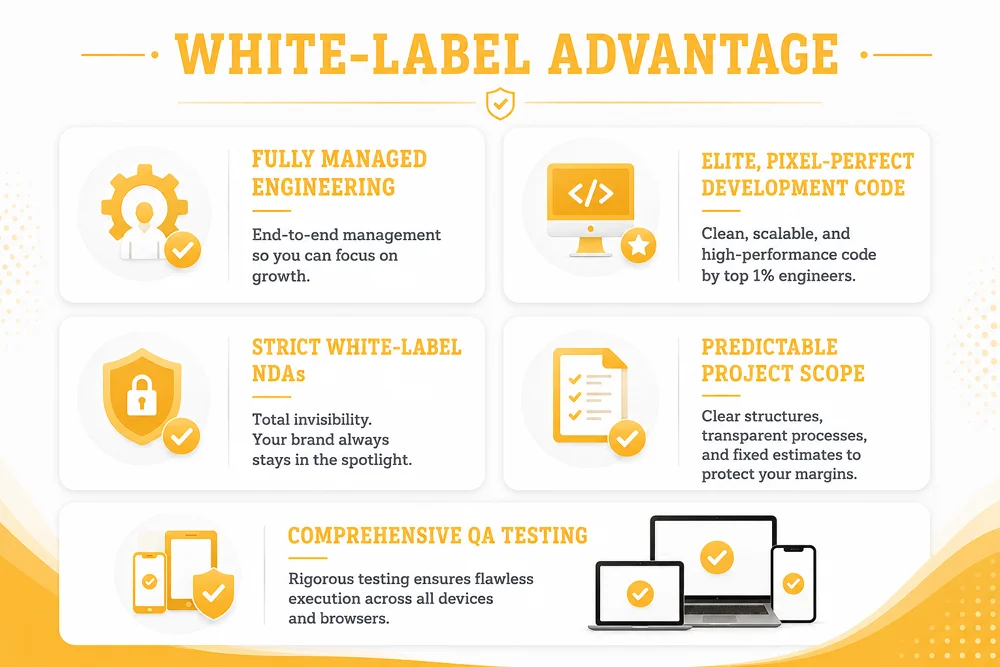
For agencies looking to completely bypass the stress of hiring while unlocking premium development capabilities, ibrism delivers a uniquely optimized solution. ibrism operates as an elite digital production house, specializing in high performance web development, custom landing pages, and bespoke web solutions designed explicitly to help digital agencies scale.
Unlike unmanaged marketplaces or unpredictable freelance networks where you have to spend your own valuable time managing individual developers, chasing updates, and doing your own quality control, ibrism provides a fully managed, premium production layer.
Partnering with ibrism brings distinct strategic advantages directly to your agency’s bottom line:
The ultimate goal of running a successful agency is to maximize your revenue and client impact while minimizing operational friction and fixed financial liabilities. White label web development successfully decouples your agency’s growth from the constant, exhausting pressure of hiring and managing a massive internal tech team.
Instead of carrying steep full time engineering payrolls during seasonal market fluctuations, you can transition your business into an agile, highly profitable, and scale ready model that expands or contracts perfectly alongside your actual project pipeline.
If your agency is ready to stop turning down lucrative web projects, expand your technical capabilities instantly, and unlock premium dev capacity under your own brand, it’s time to build a smarter delivery engine.